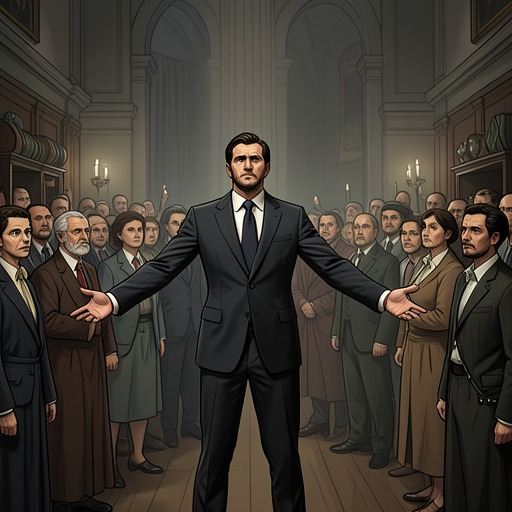
Verlin M. Taylor
The Plot Against AmericaVerlin M. Taylor enters the Roth family’s Washington visit as a professional guide and becomes more than a source of information: he drives them through the capital, interprets its civic landmarks, and steps in when a hotel dispute leaves them without a secure place to stay. His expertise gives the family a guided route through national history; his practical assistance makes that route possible at a moment when the promise of equal treatment has failed them.
Identity and Introduction
Taylor introduces himself beside the Roth family’s automobile after they return to the street from their hotel to find lunch. He presents himself as an official guide to Washington, D.C., and offers to drive the family in its own car, take them to the sights, provide explanations, wait while they visit, and recommend places to eat. His proposed fee is nine dollars a day. Rather than relying on a sales pitch alone, he unfolds several pages of authorization issued by the Chamber of Commerce.
Taylor says he has been an official guide since January 5, 1937, the day the Seventy-fifth U.S. Congress convened. His careful statement of the date and his papers establish credentials that the family can inspect. Herman Roth examines them in the manner of an insurance man, then negotiates the rate down to seven dollars. Taylor accepts, and the two seal the arrangement with a handshake. The transaction makes him part of the family’s day, but also introduces a characteristic combination: he is both a knowledgeable public professional and a resourceful person willing to adapt his services to the family’s means.
The narrator, Philip Roth, registers the oddity of the family’s new arrangement: having traveled from New Jersey to the capital in their own automobile, they are now being chauffeured by a stranger whose surname matches that of a president represented in Philip’s stamp album. The detail places Taylor within a child’s particular way of noticing the world, where a guide’s name can connect the present journey to the carefully preserved images of the past.
A Guide to the Capital
Taylor argues that the family will see and enjoy more with him than by trying to drive, navigate, and find parking on their own. He proposes beginning with the Washington Monument and continuing down the Mall to the Lincoln Memorial, presenting the route through the capital’s most prominent memorials as a deliberate introduction to the country’s political history. His explanations range beyond directions. He describes Washington, D.C., as divided into four sections, explains its numbered north–south streets and lettered east–west streets, and emphasizes that the city was developed specifically to house the national government.
That account catches Herman’s attention. He turns to Sandy and Philip to ask whether they heard Taylor’s explanation, then asks Bess as well. Bess takes Philip’s hand, a small gesture that connects the guide’s confident account of the city to the family’s private effort to feel reassured during their trip. Taylor is not simply listing sights: his explanation gives the capital an organizing idea, and Herman takes it as something worth sharing with his children.
His command of public history becomes especially visible on the family’s next full day of touring. Taylor shows them the Capitol and Congress, then the Supreme Court and the Library of Congress. He knows the height of domes, the dimensions of lobbies, the geographic origins of marble flooring, and the subjects and commemorated events in paintings and murals. Herman praises him as a small-town boy from Indiana who should be on Information Please. The compliment recognizes the scale and precision of Taylor’s knowledge, while the itinerary shows that his expertise is practical: it accompanies the family through the actual buildings rather than remaining a performance of facts.
After lunch, Taylor drives south along the Potomac into Virginia to Mount Vernon. There he continues to place the landscape within a longer national history, discussing Virginia’s role in the Civil War, nearby battlefields, and the surrender at Appomattox. His guiding turns travel into a sequence of explanations linking places to political events. The family sees the region through both its landmarks and Taylor’s account of what happened there.
Assistance During the Hotel Dispute
Taylor’s role changes when the Roth family becomes embroiled in a dispute with the manager of the Douglas. Herman insists that the police be called and says there are laws against people like the manager. With five or six other guests watching in the lobby, Taylor steps beside him and says that Herman is right but that the police are the wrong solution. The scene puts Taylor’s practical judgment beside Herman’s insistence on invoking the law: Taylor does not deny his claim, but tries to move the family toward immediate assistance rather than a confrontation that is still unfolding in public.
As the manager reaches for the telephone, Taylor carries the family’s bags out of the hotel, two in each hand. Bess tells Herman that Taylor has taken them, but Herman remains determined to wait for the police and have the manager reminded of the words of the Gettysburg Address he had seen carved that day. Taylor runs back into the lobby while the call is being completed and speaks to Herman in a lowered voice. He has telephoned another hotel from a nearby booth, confirmed that it has a room, and urges the family to drive there and register. His intervention is immediate and concrete: while the argument centers on justice and the police, he has already found the family somewhere else to go.
At the Evergreen, the accommodation Taylor has located is modest. The room is smaller than the first one, the bathroom has been heavily disinfected but still smells wrong, and the beds are not ideal for rest. The family nevertheless encounters a cheerful welcome and does not complain after what happened at the Douglas. Taylor’s contribution is not to make the circumstances comfortable, but to secure an alternative quickly enough for them to continue their stay.
Character and Narrative Role
Taylor is shown through what he can do: produce authorization, negotiate a workable arrangement, navigate the city, interpret its buildings and history, and respond swiftly when the family needs a different hotel. The narrative does not provide an account of his private life beyond his description of himself as a small-town boy from Indiana and his stated professional tenure. His characterization instead accumulates through the details of service and competence, from exact architectural measurements to the telephone call made from a booth outside the hotel.
His part in the journey also places civic ideals beside lived circumstances. Taylor explains the capital as a city designed for national government and takes the family through its institutions and memorials; later, he helps them leave a hotel after a dispute in which Herman appeals to the country’s laws. The contrast gives Taylor’s guiding a significance beyond sightseeing. He makes the national story visible in buildings and historical sites, but his most urgent help is not an explanation: it is carrying the bags and finding another room. Through that shift, he becomes a practical ally in the family’s encounter with the gap between the country’s public promises and their vulnerable position as visitors.